Wednesday, October 8, 2014

POEM: "Recently A Fellow Poet Wrote"


Recently A Fellow Poet Wrote


Recently a fellow poet wrote:
Highjacked by a book of poems, I want
To know more about my captor. What
Has given rise to such intentions?

Diesel smack and smeared mirages
A searing mark under a damning sun
Off the track from an untargeted village
Safe enough for the story and the pics

Now, I don't want to know more about them
(I overstepped my bounds, they're very twitchy)
I want to know about my options to get free
And except for my camera, I'm unrifled
And except for my passport
I’m fucked.


© 2014 Rob Schackne

Tuesday, October 7, 2014

POEM: "Listening To Birds At Dawn"


Listening To Birds At Dawn


And the machinery we depend on
Lasts till we get where we’re going
Five minutes or five inches in reserve
Our heart pounds guessing we made it
(Five pounds more and we wouldn't have)
Hardly feeling five of the something less
Could crash this plane, could send us
Out of control, desperate, terrified;
Strange craft, the inefficiency by
Which the world runs fractured
As if the doors that barely close
Contained enough for long enough

That it all worked fine before the system
We almost had worked out, gave up.


© 2014 Rob Schackne

Sunday, October 5, 2014

A Jessica Greenbaum Poem


A Poem for S.


Because you used to leaf through the dictionary,
Casually, as someone might in a barber shop, and
Devotedly, as someone might in a sanctuary,
Each letter would still have your attention if not
For the responsibilities life has tightly fit, like
Gears around the cog of you, like so many petals
Hinged on a daisy. That's why I'll just use your
Initial. Do you know that in one treasured story, a
Jewish ancestor, horseback in the woods at Yom
Kippur, and stranded without a prayer book,
Looked into the darkness and realized he had
Merely to name the alphabet to ask forgiveness—
No congregation of figures needed, he could speak
One letter at a time because all of creation
Proceeded from those. He fed his horse, and then
Quietly, because it was from his heart, he
Recited them slowly, from aleph to tav. Within those
Sounds, all others were born, all manner of
Trials, actions, emotions, everything needed to
Understand who he was, had been, how flaws
Venerate the human being, how aspirations return
Without spite. Now for you, may your wife's
X-ray return with good news, may we raise our
Zarfs to both your names in the Great Book of Life.


(2012)

Saturday, October 4, 2014

MUSIC: Japan, "Ghosts" (1982)


David Sylvian sings:

Just when I think I'm winning
When I've broken every door
The ghosts of my life
Blow wilder than before


Just when I thought I could not be stopped
When my chance came to be king
The ghosts of my life
Blew wilder than the wind

MUSIC: The Royalettes, "It's Gonna Take A Miracle" (1965)


I know, I know. That's not their real hair. This is the cheesiest clip you ever saw. Black and white sucks. They don't make music like this anymore. Now shut up.

Friday, October 3, 2014

WOODBLOCK PRINT: Yuko Shimizu (2014)


POEM: "Letter From My Apartment, Oct. 3, 2014"


Letter From My Apartment, Oct. 3, 2014


Love predates nationalities
Wind originates beyond the sky
Earth has water older than the sun

Still things will travel faster than light
(I could go on but you're grateful I won’t)
No one lives in caves though we might as well
A poem of white is no more the absence of colours
Than a poem of black includes them all forever
And though a red umbrella is small protection
Against the ravages of teargas in Hong Kong
A bottle of water applied to the eyes will help.


© 2014 Rob Schackne

Wednesday, October 1, 2014

MUSIC: Fatboy Slim, "Weapon of Choice" / Christopher Walken (2010) / POEM: "Right" (2014)


http://www.youtube.com/watch?v=wCDIYvFmgW8


Right. Flow.
Left foot goes there
no, the other right
now unweight the right
let it slide over to the left
hands block and turn  if
you walk without rhythm
ah, you never learn
now let's try it again.


© 2014 Rob Schackne

Tuesday, September 30, 2014

A Kenneth Koch Poem


One Train May Hide Another


In a poem, one line may hide another line,
As at a crossing, one train may hide another train.
That is, if you are waiting to cross
The tracks, wait to do it for one moment at
Least after the first train is gone. And so when you read
Wait until you have read the next line—
Then it is safe to go on reading.
In a family one sister may conceal another,
So, when you are courting, it's best to have them all in view
Otherwise in coming to find one you may love another.
One father or one brother may hide the man,
If you are a woman, whom you have been waiting to love.
So always standing in front of something the other
As words stand in front of objects, feelings, and ideas.
One wish may hide another. And one person's reputation may hide
The reputation of another. One dog may conceal another
On a lawn, so if you escape the first one you're not necessarily safe;
One lilac may hide another and then a lot of lilacs and on the Appia Antica
     one tomb
May hide a number of other tombs. In love, one reproach may hide
   another,
One small complaint may hide a great one.
One injustice may hide another—one colonial may hide another,
One blaring red uniform another, and another, a whole column. One bath
   may hide another bath
As when, after bathing, one walks out into the rain.
One idea may hide another: Life is simple
Hide Life is incredibly complex, as in the prose of Gertrude Stein
One sentence hides another and is another as well. And in the laboratory
One invention may hide another invention,
One evening may hide another, one shadow, a nest of shadows.
One dark red, or one blue, or one purple—this is a painting
By someone after Matisse. One waits at the tracks until they pass,
These hidden doubles or, sometimes, likenesses. One identical twin
May hide the other. And there may be even more in there! The
   obstetrician
Gazes at the Valley of the Var. We used to live there, my wife and I, but
One life hid another life. And now she is gone and I am here.
A vivacious mother hides a gawky daughter. The daughter hides
Her own vivacious daughter in turn. They are in
A railway station and the daughter is holding a bag
Bigger than her mother's bag and successfully hides it.
In offering to pick up the daughter's bag one finds oneself confronted by
   the mother's
And has to carry that one, too. So one hitchhiker
May deliberately hide another and one cup of coffee
Another, too, until one is over-excited. One love may hide another love or
   the same love
As when "I love you" suddenly rings false and one discovers
The better love fingering behind, as when "I'm full of doubts"
Hides "I'm certain about something and it is that"
And one dream may hide another as is well known, always, too. In the
   Garden of Eden
Adam and Eve may hide the real Adam and Eve.
Jerusalem may hide another Jerusalem.
When you come to something, stop to let it pass
So you can see what else is there. At home, no matter where,
Internal tracks pose dangers, too: one memory
Certainly hides another, that being what memory is all about,
The eternal reverse succession of contemplated entities. Reading A
   Sentimental Journey look around
When you have finished, for Tristram Shandy, to see
If it is standing there, it should be, stronger
And more profound and theretofore hidden as Santa Maria Maggiore
May be hidden by similar churches inside Rome. One sidewalk
May hide another, as when you're asleep there, and
One song hide another song; a pounding upstairs
Hide the beating of drums. One friend may hide another, you sit at the
   foot of a tree
With one and when you get up to leave there is another
Whom you'd have preferred to talk to all along. One teacher,
One doctor, one ecstasy, one illness, one woman, one man
May hide another. Pause to let the first one pass.
You think, Now it is safe to cross and you are hit by the next one. It can be
   important
To have waited at least a moment to see what was already there.


(1994)

Sunday, September 28, 2014

A T.S. Eliot Poem


Preludes


I

The winter evening settles down
With smell of steaks in passageways.
Six o’clock.
The burnt-out ends of smoky days.
And now a gusty shower wraps
The grimy scraps
Of withered leaves about your feet
And newspapers from vacant lots;
The showers beat
On broken blinds and chimney-pots,
And at the corner of the street
A lonely cab-horse steams and stamps.

And then the lighting of the lamps.


II

The morning comes to consciousness
Of faint stale smells of beer
From the sawdust-trampled street
With all its muddy feet that press
To early coffee-stands.
With the other masquerades
That time resumes,
One thinks of all the hands
That are raising dingy shades
In a thousand furnished rooms.


III

You tossed a blanket from the bed,
You lay upon your back, and waited;
You dozed, and watched the night revealing
The thousand sordid images
Of which your soul was constituted;
They flickered against the ceiling.
And when all the world came back
And the light crept up between the shutters
And you heard the sparrows in the gutters,
You had such a vision of the street
As the street hardly understands;
Sitting along the bed’s edge, where
You curled the papers from your hair,
Or clasped the yellow soles of feet
In the palms of both soiled hands.


IV

His soul stretched tight across the skies
That fade behind a city block,
Or trampled by insistent feet
At four and five and six o’clock;
And short square fingers stuffing pipes,
And evening newspapers, and eyes
Assured of certain certainties,
The conscience of a blackened street
Impatient to assume the world.

I am moved by fancies that are curled
Around these images, and cling:
The notion of some infinitely gentle
Infinitely suffering thing.

Wipe your hand across your mouth, and laugh;
The worlds revolve like ancient women
Gathering fuel in vacant lots.


(1917)

Friday, September 26, 2014

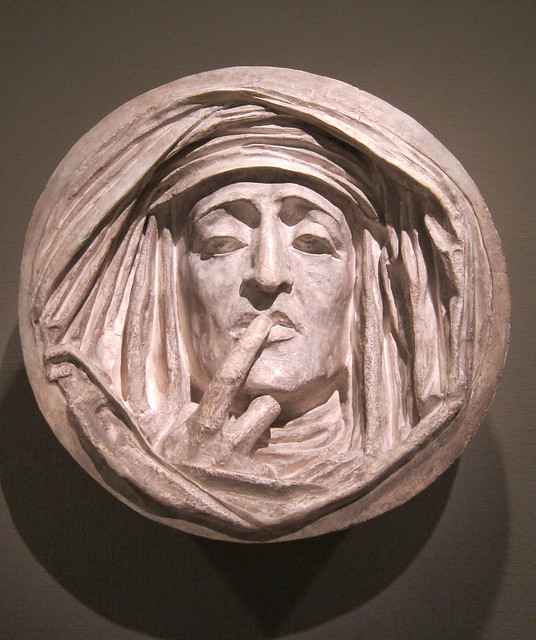
PHOTO: Gil Roth, "Le Silence" / POEM: "First Day In The Afterlife"


First Day In The Afterlife


Don't get around much any more

(I might not get around at all)
silenced with a middle finger
waiting to do nothing more than
live a life, write, fight, then fuck off
(the Silenus kicks over a few chairs
and he quickly gallops away)

"...reality scarier than science fiction
he says pushing against the storm
crashing rain, the deck is non-negotiable
the din of wind is furious, others below
with their smokes and bottles play cards
betting both ends against the middle"


My first day in the Afterlife

I have an horrible hangover, also 
an idea almost on the verge of memory
there was a victory, yes, the plan worked
very few casualties, the flag, the wind etc.
but I'm an eagle now and when I fly over
all is silent, beautiful, covered in trees

One streaks past 
— then another one fast
I wonder what they are, what they do
so many of them zipping from yes to no
the speed means I need to slow down now
it's the Afterlife after all, they shout at me
pause it, restart, look closely, look again
and watch it happening for the first time.


© 2014 Rob Schackne

Tuesday, September 23, 2014

A Jim Daniels Poem


Work Boots: Still Life 


Next to the screen door
work boots dry in the sun.
Salt lines map the leather
and laces droop
like the arms of a new-hire
waiting to punch out.
The shoe hangs open like the sigh
of someone too tired to speak
a mouth that can almost breathe.
A tear in the leather reveals
a shiny steel toe
a glimpse of the promise of safety
the promise of steel and the years to come.


(2003)

POEM: "Note To The Dead-in-Spirit"


Note To The Dead-in-Spirit


Restless, not knowing, we turn away
Convinced that some things aren't real

Anguished and angry, wailing, taking lies
To bed with us, we wake to tell no one


Keep no blanket, save nothing from burning
Brook no curiosity about who or what set the fire
Because we're iced. We can't stop this shivering
Every night remembering how it was to sleep

There's no profit in suffering our childhoods
We suffer our neighbours, our lives, our selves
The spirit's dead and the dream is moribund
These times can't be sustained. We mustn’t hope

When reversed, humbled, change emerges
We crawl about the floor, a sunny day yawns
Rubs its eyes with the eyes of some other
Retains another second’s warmth of wonder.


(2005)

Sunday, September 21, 2014

MUSIC: Tears For Fears, "Mad World" (1983)


I know, I know. Now leave me alone.


A Philip Levine Poem


Among Children


I walk among the rows of bowed heads--
the children are sleeping through fourth grade
so as to be ready for what is ahead,
the monumental boredom of junior high
and the rush forward tearing their wings
loose and turning their eyes forever inward.
These are the children of Flint, their fathers
work at the spark plug factory or truck
bottled water in 5 gallon sea-blue jugs
to the widows of the suburbs. You can see
already how their backs have thickened,
how their small hands, soiled by pig iron,
leap and stutter even in dreams. I would like
to sit down among them and read slowly
from The Book of Job until the windows
pale and the teacher rises out of a milky sea
of industrial scum, her gowns streaming
with light, her foolish words transformed
into song, I would like to arm each one
with a quiver of arrows so that they might
rush like wind there where no battle rages
shouting among the trumpets, Hal Ha!
How dear the gift of laughter in the face
of the 8 hour day, the cold winter mornings
without coffee and oranges, the long lines
of mothers in old coats waiting silently
where the gates have closed. Ten years ago
I went among these same children, just born,
in the bright ward of the Sacred Heart and leaned
down to hear their breaths delivered that day,
burning with joy. There was such wonder
in their sleep, such purpose in their eyes
dosed against autumn, in their damp heads
blurred with the hair of ponds, and not one
turned against me or the light, not one
said, I am sick, I am tired, I will go home,
not one complained or drifted alone,
unloved, on the hardest day of their lives.
Eleven years from now they will become
the men and women of Flint or Paradise,
the majors of a minor town, and I
will be gone into smoke or memory,
so I bow to them here and whisper
all I know, all I will never know.


(1992)

Saturday, September 20, 2014

A Khaled Mattawa Poem


Date Palm Trinity


Today the date palms were pruned,
the branches taken before the fruit ripened,
before sweetness littered the sidewalks.
The man who sawed them worked alone,
a crane lifting him to the yellowed fronds.
Beside his truck, he stood tall, American,
a pensive pioneer. The top of each palm
looked like the back of a man's head
after a close-crop haircut, the neck
cooled to a stubbly remembrance of hair,
or was like a cat after being spayed,
startled by a strange newness, pacing
familiar rooms, darting, confused, and you
(had you wished to console) are greeted
with a barren gaze. The rubble of bark
and fronds reminded me of Iraq,
not the ruined bridges, or the surrendering
soldiers' hands begging food, but the 16 million
date palms, one per capita, lining
the seams of the Tigris and Euphrates,
a reminder of my own Libya
and its 10 million date palms and the years
of easy wealth that brought them neglect
except in Huun, a magical city where
they stuffed dates with almonds and sent them
as far as Tanta and Oum Dourman.
From Huun this story: a boy stands by a palm
imploring his uncle to toss him a fistful of dates.
Flustered by the boy's monotonous cries
the uncle loses his feet, and as he falls
to his death, cries down "Here nephew,
I'm coming down with the dates!"
So that's what we got from Huun, almond
stuffed wonders and proverbial last words.
There was another reminder, a tale
of the prophet Muhammad living for months
on water and coarse wheat bread, his wives
protesting the austere measures of his faith.
Muhammad, who praised honey and had
a professed love for cantaloupes, and who once
declared "the best meat is that which lines the bones,"
found in dates the solution he required.
To his Arab followers, and to his wives,
the fruit was "three skies above luxury,"
and as indispensable as water and air.


I once had this dream of Whitman:
I found him under one of the palms
on Sherman Way gazing admiring.
Though he had seen palms by the Gulf of Mexico,
he had never tasted a date. So we drove
to a supermarket, and he who had been
thoughtful, even dignified, until then, began
to sign and moan at the taste of "Araby's
sugared dust clouds." When we walked
the aisles he insisted on pushing the cart.
The frozen foods did not surprise him since
his Granny buried potatoes in the cold dirt
of her homestead. Still I had to explain
tofu, plastic, tacos, and the foods labeled free.
He ran his hands caressing the waxed floor;
"Smooth as a girl's wrist," he exclaimed.
The bright fluorescent lights reminded him
of the opera, and Walt sang a gravelly tune.
The children sitting in carts reached for him,
their hands were Lorca's butterflies on his beard.
At the cashier he filled pockets with candy,
and was shocked by the headlines of our news.
Honda, Toyota, Saturn, Oldsmobile—
in the parking lot the names waltzed
on his tongue. At the fast food stand he ate
heartily, the burger's slipperiness amused him,
and at his clumsiness we both had a laugh.
Then the talk grew quiet, the table stretching
like the expanse of time dividing us; I felt
he no longer wanted company, having begun
to understand our world. Despite his old resentment
of Blacks, and now my neighbors, the foreign-born
Hispanics and their engines roaring through
Balboa and Saticoy, and the Koreans' karoake—
the baseline's muffled thuds, voices doused
in Canadian Mist, and the off-key pleadings
to the lover who never comes—, America
remained to him luminous-industrial-fuming-
sublime, and as he wished, beyond others'
adjectives, beyond what anyone could have conceived.
Mumbling a farewell, Whitman stood to leave.
And with this my dream ended, Whitman wishing
to depart and I holding on to his wrists.
All day I wanted to hold his wide wrists.


If you drive west of Alexandria
your path will run through Alamain,
Barani, and Matrouh. Then Egypt will end
with a town on a steep hill called Sallum.
If you go through the two checkpoints,
Libya will unfold its dry pastures for you.
On the Sallum hill there is a hotel
where people stay to await relatives
crossing the border or to hear word
if it is safe to return. Across the road
a tired bluegreen tea house sits
like a bruise permanently on the verge
of fading from the prairies' skin.
You will also see the money changers—
all teenage boys. With their right hands
they will wave thick wads of money
at your windshield, and with their left
they will jostle to give you the best rate.
The last time I stayed in Sallum
few cars came from either direction,
and among the boys fights flared
with curses and stones hurled at brows.
When the boys' rabble grew loud
a man lazily stepped out of the tea house
to call them bastards and sons of whores.
This went on for hours until
the sun settled in the middle of the sky,
the boys taking shelter under
a torn canvas shed, and the man
to the tea house's dusty cool.
Then just when all movement
and noise seemed to surrender
to the September wind and heat,
four of the boys broke for a run
racing—money still clutched in their hands—
to a young date palm in the distance.
Pressing shoulders and backs against it,
they shook the palm until the season's
first fruit began to rain. The other boys
joined them, and soon the tea house
emptied of the men slouching inside.
Those were my brothers who cowered beneath
the date palm to gather handfuls of fruit,
rubbing each date clean on their sleeves,
chewing softly to savor the taste
as though it were a good omen, and rising
to resume their lives, on their faces
the smiles of those who once were blessed.


(1995)

Thursday, September 18, 2014

POEM: "At Some Point During The Night"


At Some Point During The Night


I wonder whether every sip takes and gives
away something that’s never coming back.
The illusionist so expert at indirecting
the familiar from other matters nods wisely
then pours another one. Hardly knowing why.
We barely know enough to quit. Though it’s true
that visions will read the first chapters of the mind.
But wear and tear affects the world. Snake laughs
and gives my skin to a pretty Muse who sits
with her long legs spread apart on the barstool
sipping a wet martini. Her blouse is open.
She gazes. She grins. Pokes out her tongue.
Wants me to sit down. She buys the drinks.
Keeps smiling. Not sure about this summation
or whether it’s much of a guide to being normal.


© 2014 Rob Schackne

Wednesday, September 17, 2014

POEM: "Dusk"


Dusk


Shanghai dusk, there is
something in the wind
(I can’t see what it is)
a woman might be good
smile and smell conjoint
maybe some nalaizhuyi
a love without study
a joy without learning
change plus knowledge
whichever is the case
tomorrow is coming fast
(morning to be different)
I sense transfiguration
I can see maybe three things.


© 2014 Rob Schackne

POEM: "Untitled Beetles"


Untitled Beetles

                                         for Patterson Schackne

I too believe that beetles speak from longing
loved by a God that never speaks to them
that after looking around for somebody
else to do the work finally it's up to them
the beetle people the beetle poets
to examine the records very closely
for the ones that work closest to the outer bark

and listen for the scratches near the heart
scrying and carving a message no one hears
except you and me and that small child over there
also loved by a God that can't clean up his mess
this one encouragement is our commonality
as we see the souls gathering in their places
under the sky by the trees standing in the wind


© 2014 Rob Schackne

Tuesday, September 16, 2014

A Clive James Poem (2)

Japanese Maple


Your death, near now, is of an easy sort.
So slow a fading out brings no real pain.
Breath growing short
Is just uncomfortable. You feel the drain
Of energy, but thought and sight remain:

Enhanced, in fact. When did you ever see
So much sweet beauty as when fine rain falls
On that small tree
And saturates your brick back garden walls,
So many Amber Rooms and mirror halls?

Ever more lavish as the dusk descends
This glistening illuminates the air.
It never ends.
Whenever the rain comes it will be there,
Beyond my time, but now I take my share.

My daughter’s choice, the maple tree is new.
Come autumn and its leaves will turn to flame.
What I must do
Is live to see that. That will end the game
For me, though life continues all the same:

Filling the double doors to bathe my eyes,
A final flood of colors will live on
As my mind dies,
Burned by my vision of a world that shone
So brightly at the last, and then was gone.


(2014)

Monday, September 15, 2014

POEM: "Why I Don't Want To Own The North Pole"


Why I Don’t Want To Own The North Pole


You will see it for yourself
the ocean in children’s eyes
and how the ordinary people
graduated from chocolate
think they should own the pieces of the world

It was the assumption of
some inviolate wilderness
someplace on this blessèd planet
chose itself should be the braincap
(South Pole wants to be the female partner)

And now it's our didactic
the tantrums are forgiven
because we've got a brand new plan
one-two collect the small planet
(likely to be too much Brainiac there)

We wander the old market
we'll buy our codfish frozen
far beneath the arctic waters
drumming the probable reserves
while oligarchs watch us from submarines.


© 2014 Rob Schackne

MUSIC: Townes Van Zandt, "The Highway Kind"


The great Townes Van Zandt. A favourite song? Probably.

http://www.youtube.com/watch?v=QFBr-GQqt6A

Sunday, September 14, 2014

A Christian Wiman Poem


After The Diagnosis


No remembering now
when the apple sapling was blown
almost out of the ground.
No telling how,
with all the other trees around,
it alone was struck.
It must have been luck,
he thought for years, so close
to the house it grew.
It must have been night.
Change is a thing one sleeps through
when young, and he was young.
If there was a weakness in the earth,
a give he went down on his knees
to find and feel the limits of,
there is no longer.
If there was one random blow from above
the way he's come to know
from years in this place,
the roots were stronger.
Whatever the case,
he has watched this tree survive
wind ripping at his roof for nights
on end, heats and blights
that left little else alive.
No remembering now...
A day's changes mean all to him
and all days come down
to one clear pane
through which he sees
among all the other trees
this leaning, clenched, unyielding one
that seems cast
in the form of a blast
that would have killed it,
as if something at the heart of things,
and with the heart of things,
had willed it.


(2011)

Friday, September 12, 2014

An Adam Zagajewski Poem (2)

Try to Praise the Mutilated World


Try to praise the mutilated world.
Remember June's long days,
and wild strawberries, drops of rosé wine.
The nettles that methodically overgrow
the abandoned homesteads of exiles.
You must praise the mutilated world.
You watched the stylish yachts and ships;
one of them had a long trip ahead of it,
while salty oblivion awaited others.
You've seen the refugees going nowhere,
you've heard the executioners sing joyfully.
You should praise the mutilated world.
Remember the moments when we were together
in a white room and the curtain fluttered.
Return in thought to the concert where music flared.
You gathered acorns in the park in autumn
and leaves eddied over the earth's scars.
Praise the mutilated world
and the gray feather a thrush lost,
and the gentle light that strays and vanishes
and returns.


(2002)

Thursday, September 11, 2014

POEM: "Wind Leaves"


Wind Leaves


I'm standing in a forest bumped by trees
but the great sky looks plainly visible

A fresh breeze is just beginning to stir
A drop of something lands on my head

Nothing above the belt, nothing red
I have misunderstood her too easily

The trees are often fooled by the forest
While the forest responds to the wind

The waves are shaking the leaves again
Nothing below the belt, nothing blue

Each new breeze reacts to her storm
To her breath, her songs, her poems

The leaves are shaking the waves again
I am suspected of speaking my mind.


© 2014 Rob Schackne

Sunday, September 7, 2014

MUSIC: The Verve, "Bitter Sweet Symphony" (Glastonbury, 2008)


Ten years after the bitter sweet event, another bitter sweet event. Some events, they work like that. Bitter and sweet. Please don't go.

https://www.youtube.com/watch?v=3GnWRjoP9mQ

Saturday, August 30, 2014

A Rosemary Nissen-Wade Poem (2)


Kuta Beach

(After Reading Lorca)


Death comes in
with the salt
at the tavern

in this country
both gentle and sinister

prancing white horses
wave-dancing men

their soft guitars at night
from across the bay

the noises
the bursts of light

mistaken for fireworks
at first

young men
with trembling hands

hard-muscled
young men of the sea
an odour of salt
and blood

death enters into the salt
as the salt enters into the death
in that tavern.


(2005)

Published Diverse-City 2006 (Anthology of the Austin International Poetry Festival, Texas)

Friday, August 29, 2014

MUSIC: Hall & Oates (1981) / Tears For Fears (1985) / Simply Red (1985)


In no special order, except for when the artists listed above recorded these songs. Listen to four short years a hundred years ago. You're a certain age, it feels good to say that pop music sucked in the 80s. But I still like these songs very much. A guilty pleasure? Hardly. I'll speed up again soon. I promise. Any day now. Really.


https://www.youtube.com/watch?v=cGZwPGsfcwM

https://www.youtube.com/watch?v=6Ni_c0IMP-c

https://www.youtube.com/watch?v=yG07WSu7Q9w

Wednesday, August 27, 2014

MUSIC: Robert Palmer, "Medley" (1974)


(Don't know which side you come down on in the matter of Robert Palmer...me, I come down on the right side.) Recorded in 1974. The Meters, Lowell George. But wait...you still calling this "white boy junk funk"?


https://www.youtube.com/watch?v=pMnzytIbH1I

Monday, August 25, 2014

POEM: "The River"


The River

                            for Rui Xiao

The sun goes down
    Life goes across

The boat tries to cross the river
  The boat can't cross the river
    The currents take it

The boat, the people
    But the poets’ voices go across

You see someone from long ago
  You can't cross the deck
    The moment takes it

What does “voices go across” mean

Does this mean distance, or else
    Is it the inability to connect

Does this mean time, or is it
    Our ageing bodies & minds

Love tries to cross the minute
  It can't cross the hours
    The currents take it

The oily swell of time
  You can't cross the river
    The moon takes it

Is anything going anywhere


© 2014 Rob Schackne

Saturday, August 23, 2014

A Rosanna Warren Poem


A Way


She said she sang very close to the mike
to change the space. And I changed the space
by striding down the Boulevard Raspail at dusk in tight jeans
until an Algerian engineer plucked the pen from my back pocket.
As if you're inside my head and you're hearing the song from in there.
He came from the desert, I came
from green suburbs. We understood
nothing of one another over glasses of metallic red wine.
I was playing Girl. He played
Man. Several plots were afoot, all
misfiring. One had to do with my skimpy black shirt
and light hair, his broad shoulders and hunger
after months on an oil rig. Another
was untranslatable. Apollinaire
burned his fingers on June's smoldering lyre
but I had lost my pen. The engineer
read only construction manuals. His room
was dim and narrow and no,
the story didn't slide that way though there are many ways
to throw oneself away.
One singer did it by living by a broken wall
until she shredded her voice but still she offered each song,
she said, like an Appalachian artifact.
Like trash along the riverbank chafing at the quay
plastic bottles a torn shirt fractured dolls
through which the current chortles an intimate tune.


(2014)

Friday, August 22, 2014

A Dylan Thomas Poem (2)


"And death shall have no dominion"


And death shall have no dominion.
Dead man naked they shall be one
With the man in the wind and the west moon;
When their bones are picked clean and the clean bones gone,
They shall have stars at elbow and foot;
Though they go mad they shall be sane,
Though they sink through the sea they shall rise again;
Though lovers be lost love shall not;
And death shall have no dominion.

And death shall have no dominion.
Under the windings of the sea
They lying long shall not die windily;
Twisting on racks when sinews give way,
Strapped to a wheel, yet they shall not break;
Faith in their hands shall snap in two,
And the unicorn evils run them through;
Split all ends up they shan't crack;
And death shall have no dominion.

And death shall have no dominion.
No more may gulls cry at their ears
Or waves break loud on the seashores;
Where blew a flower may a flower no more
Lift its head to the blows of the rain;
Though they be mad and dead as nails,
Heads of the characters hammer through daisies;
Break in the sun till the sun breaks down,
And death shall have no dominion.


(1943)

Monday, August 18, 2014

POEM: "Air Blows Through It"


Air Blows Through It


Nothing is real that wasn’t before
like a horsehead in a drum of fire
smoke floats on bone and fat


a hundred steps above the grotto
a hundred chances to get higher
I walk to the edges to be thrilled

it wants me killed a hundred times
I see a piece of honey glass
I take it and dive into the green

those old white walls so shining
below love clear deep water
love says splash doesn’t matter.


© 2012 Rob Schackne

Sunday, August 17, 2014

A Dylan Thomas Poem

"The Force That Through the Green Fuse Drives the Flower"


The force that through the green fuse drives the flower
Drives my green age; that blasts the roots of trees
Is my destroyer.
And I am dumb to tell the crooked rose
My youth is bent by the same wintry fever.

The force that drives the water through the rocks
Drives my red blood; that dries the mouthing streams
Turns mine to wax.
And I am dumb to mouth unto my veins
How at the mountain spring the same mouth sucks.

The hand that whirls the water in the pool
Stirs the quicksand; that ropes the blowing wind
Hauls my shroud sail.
And I am dumb to tell the hanging man
How of my clay is made the hangman’s lime.

The lips of time leech to the fountain head;
Love drips and gathers, but the fallen blood
Shall calm her sores.
And I am dumb to tell a weather’s wind
How time has ticked a heaven round the stars.

And I am dumb to tell the lover’s tomb
How at my sheet goes the same crooked worm.


(1957)

Saturday, August 16, 2014

A Robert Hass Poem


Winged And Acid Dark


A sentence with "dappled shadow" in it.
Something not sayable
spurting from the morning silence,
secret as a thrush.

The other man, the officer, who brought onions
and wine and sacks of flour,
the major with the swollen knee,
wanted intelligent conversation afterward.
Having no choice, she provided that, too.

Potsdamer Platz, May 1945.

When the first one was through he pried her mouth open.

Basho told Rensetsu to avoid sensational materials.
If the horror of the world were the truth of the world,
he said, there would be no one to say it
and no one to say it to.
I think he recommended describing the slightly frenzied
swarming of insects near a waterfall.

Pried her mouth open and spit in it.
We pass these things on,
probably, because we are what we can imagine.

Something not sayable in the morning silence.
The mind hungering after likenesses. "Tender sky," etc.,
curves the swallows trace in air.


(2007)

Friday, August 15, 2014

Osamu Tezuka's Astro Boy, 1963


You were 10 years old, you probably felt reason applied for the first time too. FUCK.

Wednesday, August 13, 2014

Maryam Mirzakhani, Fields Winner, 2014


Touched by Athena. Her beautifully intelligent gaze. Who knows the shape of the universe. Maryam Mirzakhani is the first woman to win the Fields Medal, the greatest prize in mathematics. But that's a realm I can barely imagine -- since I seem to have trouble adding up my own years, and I don't understand why some months can move faster than others, or how so many days will collect in a troubled week.

Friday, August 8, 2014

Thursday, August 7, 2014

A Ron Slate Poem (2)


Stop-Time


Frank McCabe bought on credit at my father’s liquor store,
they had gone to school together. Finally my father said,
teach my son to play drums and we’re even, for now.


Late afternoon lessons in his cellar, first the basics
rapped out on rubber pads, then rolls, drags, flams, paradiddles and ratamacues.
Moving on to a real kit and the flair of fills, underbelly routines
of the bass and flights between cymbals, crash and sizzle.


While I practiced, he scribbled on charts for his quintet --
Thursdays at the Knotty Pine and weddings on weekends.
No lessons for most of the summer after his heart attack.

Autumn rain, water seeping up through linoleum tiles,
staining the peeling baseboards. Mold and mildew,
back beat and double time. Smoker’s cough and drinker’s nose.
Soon he set up his kit next to mine, laying out the opening bars
of “From This Moment On” and I’d play inside him.
That’s how he put it, stay inside me and listen with your wrists.


When Mrs. McCabe came down to say they caught the man
who killed the president, he dropped the needle on “Opus One”
and said play. We listened to Krupa’s “Rockin’ Chair”
and Buddy Rich’s big band doing “Time Check.”


Lying on their sides, quarts of bourbon behind cans
of dried paint. You make the high-hat bark,
a sixteenth-note. You don’t keep time, you make time.
The standards, renowned yet open to reinvention,
thus eternal. But I lived inside a body, Mrs. McCabe returned
from the hospital with no breasts, a week later
she was playing piano upstairs while Frank critiqued me –


Don’t play with your whole arm, it looks cool
but it isn’t. He lit a Winston. Don’t be like a bass player,
use deodorant. Never let a wimp carry your gear.
Listen carefully to the songs you hate the most.


Verse and chorus, shuffle, bridge, fill, drag, fill, stop-time,
ghost-note. Rumble of the sagging boiler, steam knocking the pipes.
Soon you won’t have to remember, you’ll just make the sound.


(published in The Plume Anthology of Poetry, 2014)

Wednesday, August 6, 2014

POEM: "The Cat & The Fiddle"


The Cat & The Fiddle


What a reckless brand of trust
Yes they once loved each other well

They pledged allegiance to their winning
Now he watches the guy stuff her car
Breach running away with promise
He sighs and does 100 push-ups
His day is getting considerably worse
He can barely move the singing lark
Think Stance, Spin, Dig, and Release
The hammer thrown into the cage
(Always dangerous doing that)
When he decided it was finally over
The morning she decided to leave.


© 2014 Rob Schackne

Tuesday, August 5, 2014

An Edgar Bowers Poem


For Louis Pasteur

                                 “Who is Apollo?”                                       
                                     College student

How shall a generation know its story
If it will know no other? When, among
The scoffers at the Institute, Pasteur
Heard one deny the cause of child-birth fever,
Indignantly he drew upon the blackboard,
For all to see, the Streptococcus chain.
His mind was like Odysseus and Plato
Exploring a new cosmos in the old
As if he wrote a poem—his enemy
Suffering, disease, and death, the battleground
His introspection. “Science and peace,” he said,
“Will win out over ignorance and war,”
But then, the virus mutant in his vein,
“Death to the Prussian!” and “revenge, revenge!”

How shall my generation tell its story?
Their fathers jobless, boys for the CCC
And NYA, the future like a stairwell
To floors without a window or a door,
And then the army: bayonet drill and foxhole;
Bombing to rubble cities with textbook names
Later to bulldoze streets for; their green bodies
Drowned in the greener surfs of rumored France.
My childhood friend, George Humphreys, whom I still see
Still ten years old, his uncombed hair and grin
Moment by moment in the Hürtgen dark
Until the one step full in the sniper’s sight,
His pastor father emptied by the grief.
Clark Harrison, at nineteen a survivor,
Never to walk or have a child or be
A senator or governor. Herr Wegner,
Who led his little troop, their standards high
And sabers drawn, against a panzer corps,
Emerging from among the shades at Dachau
Stacked like firewood for someone else to burn;
And Gerd Radomski, listening to broadcasts
Of names, a yearlong babel of the missing,
To find his wife and children. Then they came home,
Near middle age at twenty-two, to find
A new reunion of the church and state,
Cynical Constantines who need no name,
Domestic tranquility beaten to a sword,
Sons wasted by another lie in Asia,
Or Strangeloves they had feared that August day;
And they like runners, stung, behind a flag,
Running within a circle, bereft of joy.

Hearing of the disaster at Sedan
And the retreat worse than the one from Moscow,
Their son among the missing or the dead,
Pasteur and his wife Mary hired a carriage
And, traveling to the east where he might try
His way to Paris, stopping to ask each youth
And comfort every orphan of the state’s
Irascibility, found him at last
And, unsurprised, embraced and took him in.
Two wars later, the Prussian, once again
The son of Mars, in Paris, Joseph Meister—
The first boy cured of rabies, now the keeper
Of Pasteur’s mausoleum—when commanded
To open it for them, though over seventy,
Lest he betray the master, took his life.

I like to think of Pasteur in Elysium
Beneath the sunny pine of ripe Provence
Tenderly raising black sheep, butterflies,
Silkworms, and a new culture, for delight,
Teaching his daughter to use a microscope
And musing through a wonder—sacred passion,
Practice and metaphysic all the same.
And, each year, honor three births: Valéry,
Humbling his pride by trying to write well,
Mozart, who lives still, keeping my attention
Repeatedly outside the reach of pride,
And him whose mark I witness as a trust.
Others he saves but could not save himself—
Socrates, Galen, Hippocrates—the spirit
Fastened by love upon the human cross.


(1997)

MUSIC: Paul McCartney & The Beatles, "The Long and Winding Road" (1970)


I don't want to get into the whole Spector thing right now. It's late and I didn't have my potatoes. But Paul's voice here is stellar. The strings sing out. The choir goes up. Phil Spector did just fine. Anyway, the road winds around forever and there's no going back. (But sure, you already knew that.)

https://www.youtube.com/watch?v=WA6HE_5Uhrs


Monday, August 4, 2014

POEM: "On The Road"


On The Road


First-quarter moon
behind the clouds tonight
emerging, disappearing
reminds me of a story
a guy told me once
that living is poisonous
all of us are born to die
and this Bardo world
means to teach us how to
forget the moon & the clouds
which is maya and maya
they will put you on your ass
I said thank you
this is my turn-off
we both laughed
you said forget this

I said not a chance.


© 2014 Rob Schackne

An Emily Dickinson Poem


"We grow accustomed to the Dark" (428)


We grow accustomed to the Dark - 
When Light is put away -
As when the Neighbor holds the Lamp
To witness her Good bye -

A Moment - We uncertain step
For newness of the night -
Then - fit our Vision to the Dark -
And meet the Road - erect -

And so of larger - Darknesses -
Those Evenings of the Brain -
When not a Moon disclose a sign -
Or Star - come out - within -

The Bravest - grope a little -
And sometimes hit a Tree
Directly in the Forehead -
But as they learn to see -

Either the Darkness alters -
Or something in the sight
Adjusts itself to Midnight -
And Life steps almost straight.


(1862)

POEM: "The Virtuous Failure Of Damn Near Everything"


The Virtuous Failure Of Damn Near Everything


Ghost images
before my owlish eye

These are hard shapes
upon the mountainside


The fungus inverted
with sharp & careful blade

I take my bearings from
the ugly tree 30 meters high


The virtuous failure of
damn near everything

I want to change my mind

A stove a pan some herbs
these steps I’ve taken

After a short gestation
the food the looks her hand


Each new word I choose
hears the cicadas cracking


Please pay better attention
Please be here right now


© 2014 Rob Schackne

POEM: "The Wonder"


The Wonder


The wonder where beauty lies
and whether it lies to us

if it had been blind for years
clubbed in the head so much
and now just relies on touch
and memory to help it see
a pretty subject or an ugly one
the purple flowers float down
a wall of ghostly photograph
slice up time any way you want
whether it joins its power to mine
or the other way round, it can't
smell the wind or feel the fragrance
but every other moment is perfect
knowing that I waited for too long.


© 2014 Rob Schackne

Sunday, August 3, 2014

MUSIC: The Allman Brothers & The Dead & The Band (1973) / Donovan (2007)


What about that mountain in Jamaica, Juanita?

http://www.youtube.com/watch?v=uS0m7hrCfHc

http://www.youtube.com/watch?v=PPoACkjZaLk

A Ha Jin Poem


Ways Of Talking


We used to like talking about grief.
Our journals and letters were packed
with losses, complaints, and sorrows.
Even if there was no grief
we wouldn’t stop lamenting
as though longing for the charm
of a distressed face.

Then we couldn’t help expressing grief.
So many things descended without warning:
labor wasted, loves lost, houses gone,
marriages broken, friends estranged,
ambitions worn away by immediate needs.
Words lined up in our throats
for a good whining.
Grief seemed like an endless river—
the only immortal flow of life.

After losing a land and then giving up a tongue,
we stopped talking of grief.
Smiles began to brighten our faces.
We laugh a lot, at our own mess.
Things become beautiful,
even hailstones in the strawberry fields.


(1996)

Friday, August 1, 2014

POEM: "Roving Thoughts"


Roving Thoughts


Roving thoughts
& the provocations
old thorns in the side
uncomfortable reminders
of both this world & the other
riding you like wind rides a rose
when the moment permits a prayer

A parent or a child
sitting on the footpath
bawling because they lost
the one I just keep travelling on
treading barefoot on fallen acorns
in the dream they are only megaphones
shouting public things that aren’t in prayers


© 2014 Rob Schackne